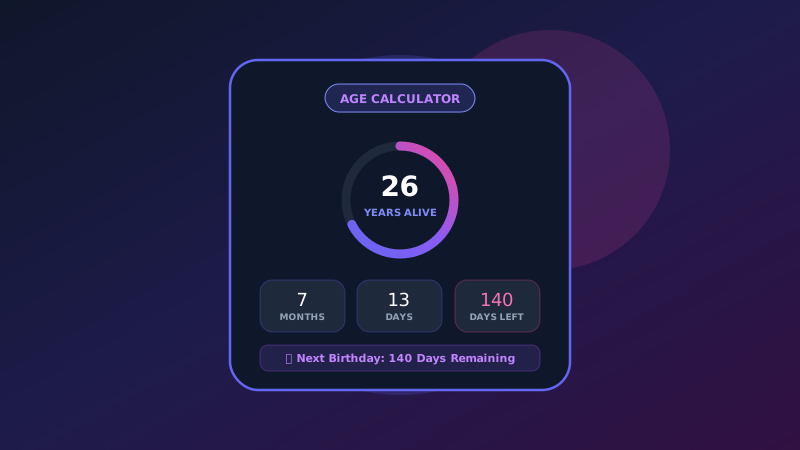
Most people can tell you their age in years without thinking twice. But ask someone their exact age in years, months, and days, and you'll usually get a pause, some finger-counting, and an answer they're only half-confident about. It's one of those calculations that feels like it should be simple — subtract one year from another — until leap years, varying month lengths, and the actual day of the month get involved.
This piece walks through how age is actually calculated, where the manual math tends to go wrong, and a few practical situations where knowing your exact age (down to the day) matters more than you'd expect.
1The Basic Formula, and Where It Breaks Down
In theory, calculating age is straightforward: subtract the birth year from the current year. If you were born in 2000 and it's 2026, you're 26. Simple enough — until you factor in whether your birthday has actually happened yet this year.
If today is March 3rd and your birthday is November 15th, that "26" is technically wrong until November rolls around. This is the first place manual calculations trip people up: subtracting years alone assumes the birthday has already passed, and if it hasn't, you need to subtract one more year than the simple math suggests.
Then there's the month and day breakdown, which is where things get genuinely messy. Months don't have a consistent number of days — February has 28 (or 29), April has 30, and so on — so calculating "how many months and days" between two dates isn't a clean subtraction. You end up borrowing days from the previous month the same way you'd borrow in a subtraction problem back in grade school, except the amount you borrow changes depending on which month you're borrowing from.
2Leap Years Make It Worse
Every four years, February gets an extra day, which throws off any age calculation that happens to span a leap year. If someone was born on February 29th specifically, the math gets even stranger — technically they only have a "real" birthday once every four years, which is why most systems default to treating their birthday as either February 28th or March 1st in non-leap years, depending on the convention being used.
3Why "Chronological Age" Specifically Matters
The term chronological age just refers to someone's actual age based on their birth date — as opposed to concepts like developmental age or biological age, which measure something different (how someone is progressing relative to typical milestones, or how their body is aging relative to their calendar age). Chronological age is the baseline everything else gets compared against, which is part of why getting it precisely right matters in certain contexts.
For a child specifically, chronological age is often used as a reference point — pediatric growth charts, developmental screening tools, and school enrollment cutoffs are usually built around exact age in years and months, not just the year someone was born. A few weeks' difference can matter more than people expect, particularly around cutoff dates for grade placement or eligibility for certain programs.
4Practical Situations Where Exact Age Comes Up
A few scenarios where the precise number (not just "I'm 26ish") actually matters:
Eligibility Cutoffs
School enrollment, sports leagues, and various programs often set age requirements as of a specific date, not the current date. Knowing your exact age on a past or future date — not just today — is genuinely useful here.
Legal & Administrative Paperwork
Certain forms ask for age in years and months rather than just years, particularly in medical, legal, or insurance contexts where precision matters. If you're managing secure accounts or forms, try our Password Generator.
Tracking Milestones
Parents tracking a child's development often want age broken down to the month, since developmental expectations shift meaningfully between, say, 14 months and 18 months in a way that "one year old" doesn't capture.
Curiosity & Birthday Countdowns
Knowing exactly how many days you've been alive, or how many days remain until your next birthday, isn't something most people need — but it's the kind of number people enjoy having on hand.
5Doing the Math Without the Manual Errors
Given how many small opportunities there are for mistakes — forgetting whether the birthday has passed this year, mishandling the month/day borrowing, missing a leap year — the most reliable approach is letting a calculator handle it rather than doing it by hand, especially if the number needs to be exact rather than approximate.
A good age calculator should give you more than just the current year-based age. Ideally it breaks the result down into years, months, and days simultaneously, lets you calculate age as of any specific date (not just today), and handles the leap-year edge cases automatically so you're not second-guessing the result. Some also show related figures — like the total number of days you've been alive, or a countdown to your next birthday — which aren't strictly necessary but are a nice way to see the underlying math from a different angle.
The date format is worth paying attention to as well. A tool that only accepts MM/DD/YYYY will silently give you the wrong answer if you're used to entering dates as DD/MM/YYYY (or vice versa), since 03/04 could mean either March 4th or April 3rd depending on which convention the tool assumes. A well-built calculator should make the expected format explicit or let you toggle between them, rather than leaving it ambiguous.
Calculating age sounds trivial but involves more moving parts than most people account for — leap years, uneven month lengths, and whether a birthday has technically occurred yet this year all affect the result. For a rough estimate, doing it in your head is fine. For anything where precision actually matters — eligibility windows, developmental tracking, legal paperwork, or just satisfying your own curiosity — it's worth letting a proper calculator do the work rather than risking a small, easy-to-make error in the manual math.
Frequently Asked Questions
Answers to common questions about age calculation math, date formats, and chronological age.
How do I calculate my exact age in years, months, and days?
Subtract your birth date from the current date, adjusting for whether your birthday has occurred yet this year and accounting for the varying number of days in each month. A dedicated age calculator handles this automatically and avoids the common manual errors.
How is chronological age calculated for a child?
The same underlying method applies — current date minus date of birth, broken into years and months — but for children it's often expressed with more precision (years and months, rather than just years) since developmental milestones are typically tracked on a monthly basis in early childhood.
Why does my age calculation come out different depending on the date format I use?
Date formats like DD/MM/YYYY and MM/DD/YYYY can be misread by tools that assume the wrong convention, especially for dates where the day is 12 or under. Always check which format a calculator expects, or use one that lets you specify it directly.
Can I calculate what my age was on a specific past date, or will be in the future?
Yes — this is a slightly different calculation from finding your current age, since it uses a target date instead of today's date, but the underlying math is the same: the difference between your birth date and whatever date you're checking against.
How many days are there between my birthday this year and today?
This is a straightforward date-difference calculation, and it's useful for anyone tracking a birthday countdown or just curious how much of the year has passed since their last birthday.